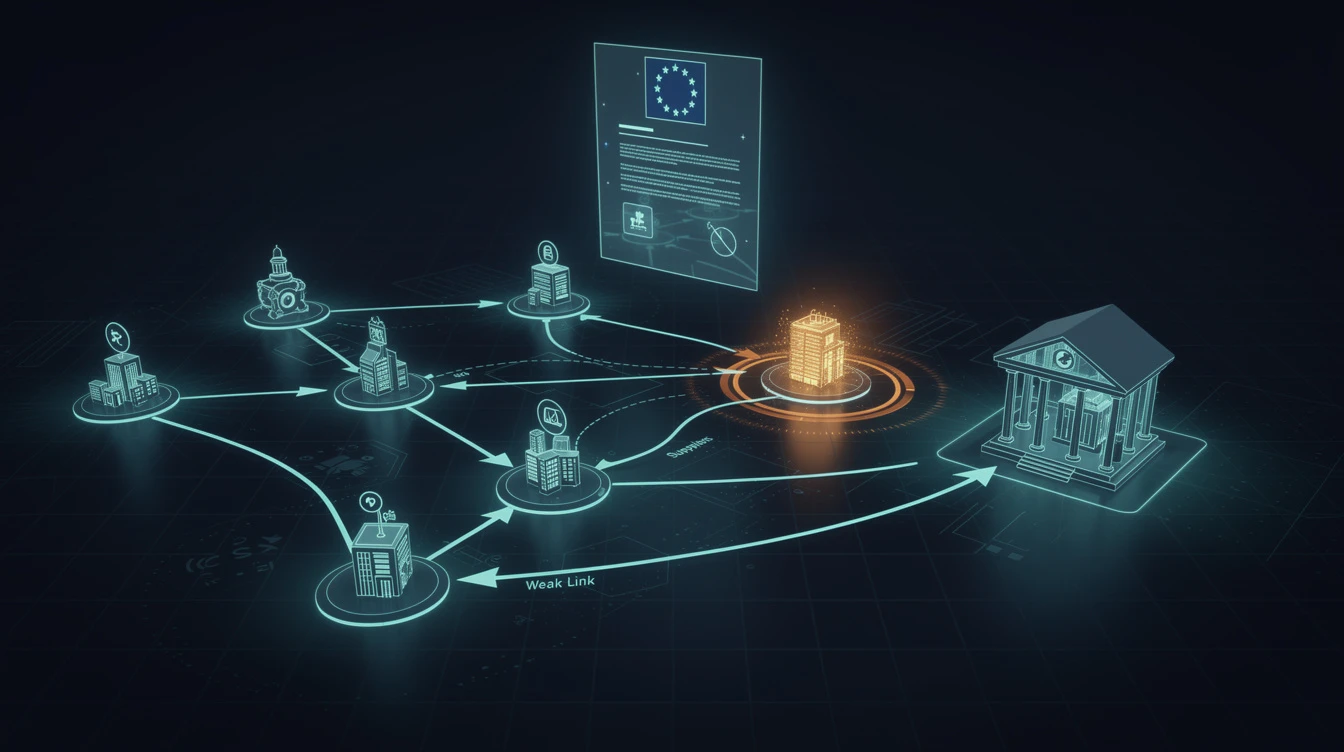
The landscape of cybersecurity in Ireland is undergoing a seismic shift, and it’s not just the big players who are feeling the tremors. If you’re a Donegal or Sligo SME, a critical piece of your business continuity now hinges on supply chain cybersecurity Ireland. You might soon find your largest and most important client knocking on your door, not with a new order, but with a detailed security questionnaire. This isn't a sign of mistrust; it's the new reality of regulatory compliance, driven largely by the EU's updated Network and Information Systems Directive, known as NIS2. For many, this will come in the form of an enterprise supplier audit, a direct consequence of these new obligations.
The Problem: A Cascade of Security Obligations
For years, cybersecurity was often viewed as a company's internal affair. You protected your own network, trained your own staff, and hoped for the best. However, modern business is a web of interconnected dependencies. A security weakness in one company can become a catastrophic breach for another, and regulators have taken notice.
The core of the problem is that your business is a link in someone else's supply chain. Your services or products are integral to your clients' operations. If a cyber attack disrupts your business, it directly impacts them. Regulators, through directives like NIS2, are now forcing large enterprises to be accountable not just for their own security, but for the security of their entire supply chain. This creates a top-down pressure wave, where large companies must audit their suppliers, who in turn may need to audit their own suppliers.
Think of it like food safety standards in a supermarket. The supermarket is responsible for the safety of the food it sells, so it audits its suppliers. The food producer, in turn, must audit the farms that provide its raw ingredients. This is the same principle now being applied to cybersecurity. The "ingredients" you provide to your clients—be it software, components, or professional services—must be proven to be cyber-resilient.
The Consequence: The Inevitable Supplier Audit
The primary driver for this change in Ireland is the NIS2 Directive. Specifically, Article 21(2)(d) mandates that regulated entities must address the "security of their supply chains". This isn't a vague suggestion; it's a legal requirement. Companies that fall under NIS2—in sectors like energy, transport, health, and digital infrastructure—face substantial fines for non-compliance, with penalties reaching up to €10 million or 2% of global turnover.
Faced with this liability, these large enterprises have no choice but to pass the security requirements down to their suppliers. This is where the NIS2 supply chain audit comes in. Your biggest client, if they are a NIS2-regulated entity, is now legally obligated to verify your cybersecurity posture. They will do this by sending you detailed security questionnaires and, in some cases, performing more in-depth audits.
What does this mean for your SME? It means that having a good product or service is no longer enough. You must now be able to prove you are a secure partner. Failure to do so could result in losing your most valuable contracts. The Garda National Cyber Crime Bureau (GNCCB) has repeatedly highlighted the supply chain as a primary vector for attacks on Irish businesses, reinforcing the urgency of this issue.
Take Action Now: Secure Your Business
Don't wait for the questionnaire to land. Proactively strengthen your security posture.
Download The Irish SME Cyber Survival Guide
The Solution: Preparing for the Audit
An impending audit shouldn't be a cause for panic. Instead, view it as an opportunity to mature your cybersecurity practices and build deeper trust with your clients. Preparation is key. The questionnaires you receive will be thorough, covering a wide range of security domains.
Here’s a comparison of what they are looking for versus what many SMEs currently have in place:
| Audit Domain | What Auditors Expect (The "Ask") | Common SME Reality (The "Gap") |
|---|---|---|
| Governance & Risk | Documented security policies, a named person responsible for security (like a vCISO), and evidence of risk assessments. | Security is informal, ad-hoc, and lacks clear ownership or documented processes. |
| Access Control | Multi-Factor Authentication (MFA) everywhere, principle of least privilege, and formal processes for onboarding/offboarding staff. | Over-privileged user accounts, inconsistent MFA use, and old employee accounts left active. |
| Data Protection | Data classification, encryption for data at rest and in transit, and robust backup and recovery plans that are regularly tested. | Unsure where all sensitive data is stored, inconsistent encryption, and backups that are rarely, if ever, tested. |
| Incident Response | A documented incident response plan, a clear process for notifying clients of a breach, and evidence of past incident handling. | No formal plan. The strategy is to "figure it out when it happens," which is a recipe for disaster. |
| Third-Party Management | A process for assessing your own key suppliers and managing that risk. | Little to no visibility into the security practices of the software and services you rely on. |
The most important step you can take is to start treating cybersecurity as a core business function, not an IT problem. This means dedicating resources, assigning responsibility, and creating a culture of security awareness from the top down. This is precisely the kind of organisational maturity that auditors want to see.
The Action: Your Practical First Steps
Facing an enterprise supplier audit can feel daunting, but you can take immediate, practical steps to prepare. The goal is not to become a cybersecurity fortress overnight, but to demonstrate a clear commitment to continuous improvement.
Identify Your Security Lead: Assign a single person within your organisation to be responsible for cybersecurity. This doesn’t need to be a full-time role in a small company, but there must be clear ownership. This person will be the point of contact for the audit.
Leverage Official Guidance: The National Cyber Security Centre (NCSC) Ireland provides excellent resources tailored for SMEs. Use their guidance as a starting point for developing your security policies and controls.
Answer the Obvious Questions First: Don't wait for the 200-question spreadsheet. Start documenting your current state. Our Supplier Readiness page outlines the common areas of focus.
Accelerate Your Response: Answering these questionnaires takes a significant amount of time and expertise. If you are time-poor and the audit is imminent, consider using a specialised service to get it done quickly and professionally. Our Security Questionnaire Fast-Track service is designed for this exact scenario.
By taking these proactive steps, you transform the audit from a threat into a competitive advantage. You show your biggest client that you are a reliable, resilient partner they can count on in this new regulatory environment.
Ready to Talk Strategy?
If you're unsure where to start or need expert guidance to navigate a supplier audit, we can help.
Book a free 20-minute strategy call
Related Reading in This Series
- How to Respond to a Customer Security Questionnaire When You Have No Security Team
- NIS2 Supply Chain Obligations: What Irish Suppliers Need to Do Before October 2026
- The 10 Questions Every Enterprise Security Questionnaire Asks — And How to Answer Them
- How to Build a Security Evidence Pack for Your Next Customer Audit
- Microsoft 365 Security Settings That Will Help You Pass Any Supplier Audit
- The Hidden Cost of Failing a Customer Security Review — And How to Pass First Time
- Cyber Insurance and Supply Chain Risk: What Insurers Now Expect from Irish Suppliers
Explore Further
Related Reading
- Supply Chain Security for Irish Seafood Exporters
- Third-Party Risk: Your Accountant, Solicitor, and IT Provider
- The Cost of NIS2 Non-Compliance: Real-World Enforcement Examples
[^1]: NCSC Ireland — Advice for Organisations: https://www.ncsc.gov.ie/advice-for-organisations/ [^2]: An Garda Síochána — National Cyber Crime Bureau: https://www.garda.ie/en/crime/cyber-crime/ [^3]: Data Protection Commission Ireland: https://www.dataprotection.ie
Pragmatic Security — Cybersecurity advisory for Irish businesses. Based in Donegal, Ireland. CISA, CISSP, CISM certified advisors.