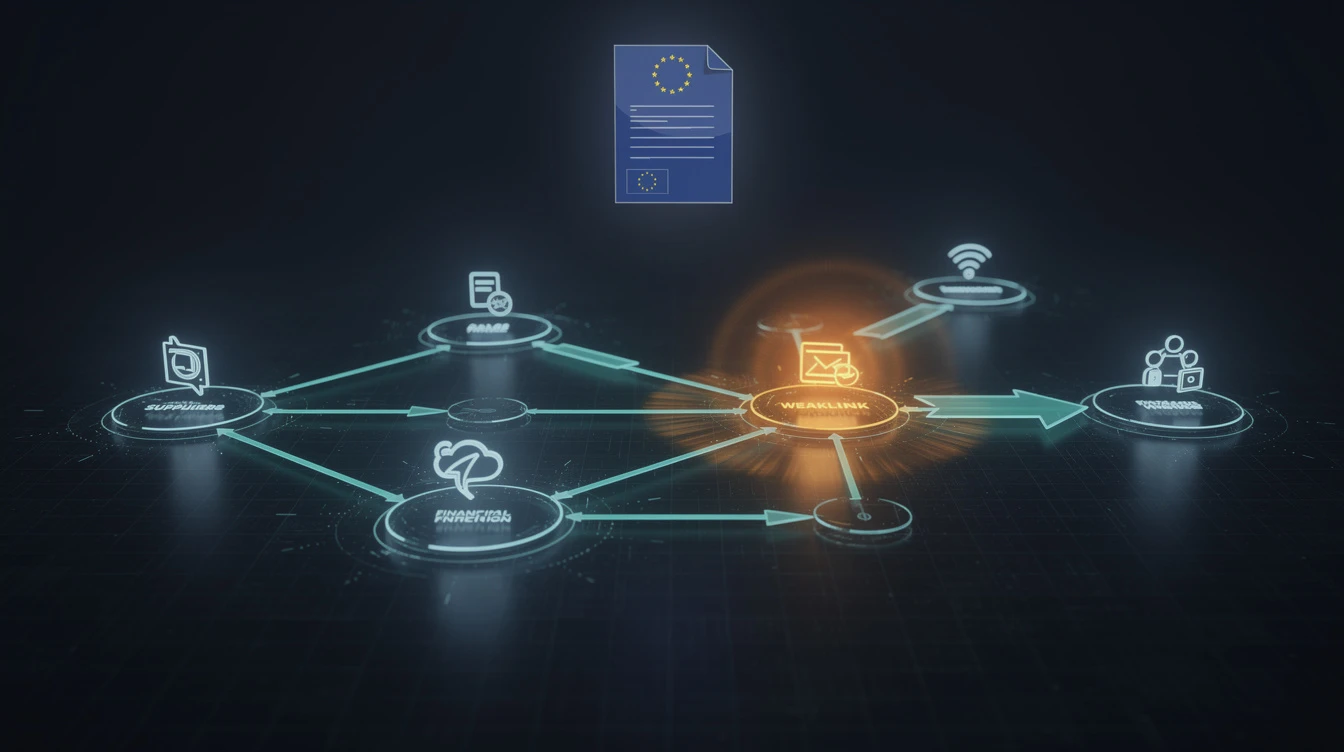
The clock is ticking towards October 2026. For many Donegal and Irish businesses, the EU's NIS2 Directive feels like a distant problem for large corporations. The reality is that NIS2 supply chain obligations will have a significant ripple effect, impacting thousands of SMEs across Ireland. If you supply goods or services to any company that falls directly under NIS2, you are part of their supply chain — and you will be expected to meet new, higher cybersecurity standards. Understanding these requirements now is critical to protecting your contracts and your business's future.
The Problem: Your Client's Compliance is Your Problem
Many Irish SMEs mistakenly believe that if they aren't a large energy provider or a major digital service, NIS2 doesn't apply to them. This is a dangerous misconception. The directive places a heavy emphasis on the security of supply chains. This means that any 'Essential' or 'Important' entity that is directly in scope of NIS2 is legally obligated to manage the cybersecurity risks posed by their direct suppliers and service providers.
According to Article 21(2)(d) of the NIS2 Directive, these entities must address "the security of their supply chains and supplier relationships, including security-related aspects concerning the relationships between each entity and its direct suppliers or service providers."
In simple terms, your biggest client is now responsible for your cybersecurity posture. They cannot afford to have a supplier with weak security, as it creates a vulnerability that could lead to a major incident, significant fines for them under NIS2, and massive reputational damage. The consequence is that if you cannot demonstrate adequate security, you risk losing your most important contracts.
The Consequence: What Happens When You're Not Prepared?
The implications of ignoring these new supply chain demands are stark. We are already seeing a dramatic increase in the number and complexity of security questionnaires being sent down the supply chain. Clients are moving from a 'trust' model to a 'verify' model. They need proof.
Imagine your biggest client, the one that accounts for 40% of your revenue, sends you a 200-question security assessment with a two-week deadline. If you can't answer it convincingly, or if your answers reveal significant gaps, you create a major problem for your client. They will be forced to either dedicate significant resources to help you improve (which they are unlikely to do for free) or, more likely, find an alternative supplier who has already invested in their security. Failing to meet these new expectations means you could be designed out of your key accounts within the next 12-24 months.
Download The Irish SME Cyber Survival Guide to get a head start on building your security foundations.
The Solution: Understanding Your Role and Taking Action
So, what does a supplier need to do? The solution is to proactively address your cybersecurity posture before it becomes a contractual crisis. You need to understand whether you are directly in scope or, more likely, indirectly affected, and then implement a baseline of security controls.
Directly in Scope vs. Indirectly Affected
First, clarify your position. A small number of suppliers might be directly in scope of NIS2 themselves if they meet the size and sector criteria. You can check if your business falls into this category by reviewing the criteria on the NCSC's website or using our NIS2 Scope Checker.
However, for the vast majority of Irish SMEs, the impact will be indirect. You are not the 'Essential Entity', but you are a critical link in their chain. Your client will be audited based on their ability to manage their suppliers, and you are one of those suppliers. This is where the real pressure will come from. They will ask you some hard questions about your supply chain security.
The 5 Minimum Controls Every Supplier Should Have
While your client's specific requirements may vary, the NIS2 directive points towards a common set of baseline security measures. Every Irish supplier should, at a minimum, have these five controls in place:
| Control Area | Description | Why It Matters for NIS2 |
|---|---|---|
| 1. Multi-Factor Authentication (MFA) | Requiring a second form of verification (e.g., a code from your phone) to access emails and critical systems. | Prevents unauthorised access to your systems, which could then be used to attack your client. |
| 2. Patch and Vulnerability Management | A process for regularly updating software and systems to fix known security holes. | Shows you are actively closing security gaps that attackers could exploit to gain a foothold. |
| 3. Secure Configuration | Hardening your systems by disabling unnecessary ports and services and changing default passwords. | Reduces the 'attack surface' of your business, making it a harder target for automated attacks. |
| 4. Backup and Recovery Plan | Regularly backing up your critical data and having a tested plan to restore it in case of a ransomware attack. | Demonstrates resilience and your ability to recover from an incident without causing major disruption to your client. |
| 5. Basic Incident Response Plan | A simple, clear plan for what to do when a security incident occurs. Who do you call? How do you communicate? | Proves you have thought about how to handle a crisis, which gives your clients confidence. |
Having these five controls in place is no longer a 'nice-to-have'; it is the new cost of doing business.
The Action: Your 3-Step Plan for NIS2 Readiness
Don't wait for the questionnaire to land. You can take control of the situation now. Here is a practical, three-step action plan for any Irish supplier.
Identify Your Gaps: Conduct a simple self-assessment against the five minimum controls listed above. Be honest about where you are strong and where you are weak. This isn't about achieving perfection overnight; it's about creating a starting baseline.
Build Your Evidence: It's not enough to do security; you must be able to prove it. For each control, gather simple evidence. This could be a screenshot of your MFA settings, a policy document for patching, or your written incident response plan. Store this in a 'Security Evidence' folder. This becomes the core of your response to any client questionnaire.
Communicate Proactively: Don't wait to be asked. Reach out to your key clients. Let them know you are aware of your NIS2 supply chain obligations and are taking proactive steps. This simple act of communication can transform your relationship from a risk to be managed into a trusted partner.
This new landscape can feel daunting, but it's also an opportunity. Businesses that invest in their security and prepare for these new requirements will have a significant competitive advantage. They will be the suppliers of choice for the thousands of Irish companies now grappling with their own NIS2 compliance.
Ready to take the next step and build a robust security strategy? Book a free 20-minute strategy call with us to discuss your specific needs.
Related Reading in This Series
- Supply Chain Cybersecurity: Why Your Biggest Client Is About to Audit You
- How to Respond to a Customer Security Questionnaire When You Have No Security Team
- The 10 Questions Every Enterprise Security Questionnaire Asks — And How to Answer Them
- How to Build a Security Evidence Pack for Your Next Customer Audit
- Microsoft 365 Security Settings That Will Help You Pass Any Supplier Audit
- The Hidden Cost of Failing a Customer Security Review — And How to Pass First Time
- Cyber Insurance and Supply Chain Risk: What Insurers Now Expect from Irish Suppliers
Explore Further
[^1]: NCSC Ireland — Advice for Organisations: https://www.ncsc.gov.ie/advice-for-organisations/ [^2]: An Garda Síochána — National Cyber Crime Bureau: https://www.garda.ie/en/crime/cyber-crime/ [^3]: Data Protection Commission Ireland: https://www.dataprotection.ie
Pragmatic Security — Cybersecurity advisory for Irish businesses. Based in Donegal, Ireland. CISA, CISSP, CISM certified advisors.