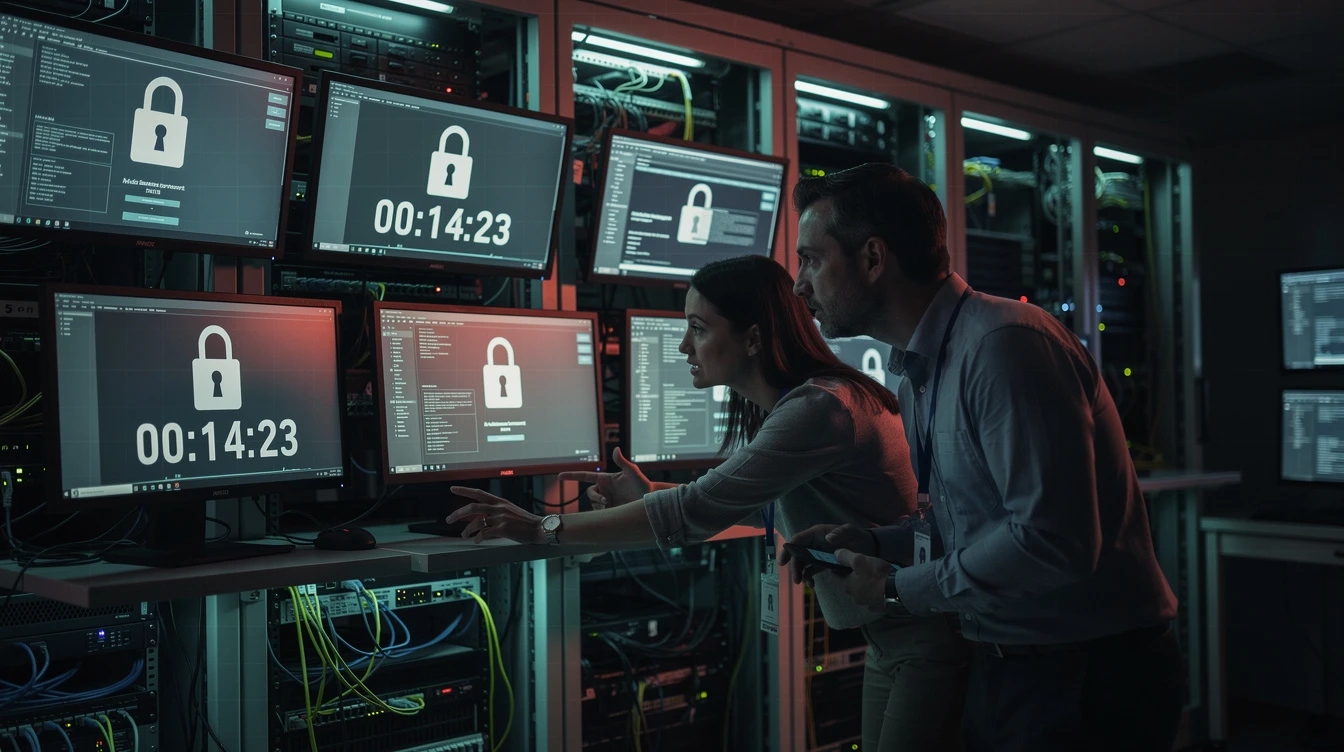
Here is a question every fish processing plant owner in Donegal, Killybegs, and across Ireland should be able to answer: what happens to your product if your blast freezer SCADA system is offline for 72 hours?
The answer, in most cases, is total loss. Fish that cannot be processed within hours of landing must be destroyed. Product in cold storage that loses temperature control becomes a food safety incident with regulatory consequences. An entire production batch with corrupted traceability data must be withdrawn from the market, even if the product itself is perfectly safe. This is why ransomware attackers target food processors, perishable goods give them maximum coercive leverage.
This is the third article in a five-part series on cybersecurity in Ireland's fishing and fish processing industry. The first article covered vessel technology risks and the second examined catch data and quota fraud. This article focuses on the processing plant floor, where legacy operational technology meets EU food safety regulation, and where a single ransomware incident during peak season can be catastrophic.
SCADA and PLC systems: legacy technology, modern threats
Fish processing plants run on operational technology (OT), SCADA systems and programmable logic controllers (PLCs) that control filleting lines, smoking ovens, blast freezers, packaging machinery, and refrigeration. These systems were designed for reliability and uptime, not for cybersecurity. Many were installed a decade or more ago and have never received a security patch.
The core problem is convergence. These OT systems, originally isolated on their own networks, are increasingly connected to the corporate IT network for monitoring, reporting and ERP integration. Larger processors connect their floor-level OT systems into enterprise ERP systems, often SAP or Sage, creating a pathway for attackers to move from the corporate network into operational systems. A phishing email that compromises an office computer can, in a poorly segmented network, lead directly to the SCADA system controlling your blast freezers.
The Sligo manufacturing case study illustrates exactly this pattern, operational technology treated as an afterthought until an incident forces the conversation. Fish processing plants face the same risk profile, with the added pressure of perishable product.
Refrigeration failure is a food safety risk
Cold chain disruption in a fish processing plant is a food safety incident with regulatory consequences and potential public health implications.
Modern refrigeration control systems, blast freezers, cold stores, ice production, are increasingly connected to SCADA networks for centralised monitoring. This connectivity is operationally efficient but creates a direct attack path. An attacker who gains access to the refrigeration control system can cause temperature excursions that spoil product, and if the monitoring system is also compromised, the spoilage may go undetected until the product has been shipped.
Under EU food safety regulations, specifically Regulation (EC) 178/2002, Irish food businesses must maintain full traceability from catch to consumer. A ransomware attack that destroys traceability data forces entire product batches to be withdrawn from the market, regardless of whether the product itself is actually contaminated. The regulatory obligation is clear: if you cannot prove the product is safe, it cannot be sold.
The financial mathematics are brutal. A processing plant handling mackerel or herring during a peak seasonal run may be processing product worth hundreds of thousands of euro per day. Three days of downtime does not mean three days of lost revenue, it means the destruction of three days of landed catch that cannot be stored, processed or sold.
Free Resource: Download The Irish SME Cyber Survival Guide, 10 controls based on NCSC Ireland and ENISA guidance. Plain English, no jargon.
Water, ice and hygiene systems
Fish processing depends on hygiene-critical systems that are increasingly networked. Water treatment, ice production and sanitation systems connected to SCADA networks represent additional attack surfaces that most plant managers have never considered from a cybersecurity perspective.
A compromise of water treatment controls in a food processing environment is a public health risk. An attacker does not need to cause visible damage, subtle manipulation of chlorination levels or water temperature could create food safety issues that only become apparent after product has been distributed. This is an extreme scenario, but it illustrates why OT security in food processing is fundamentally different from IT security in an office environment.
The peak season problem
Ransomware attackers understand seasonality. They know that a fish processor hit during the mackerel run in October or the herring season has far more to lose than one hit during a quiet period. The coercive leverage on the business owner is enormous, and attackers understand this.
This is the same dynamic that drives ransomware attacks on Irish businesses across every sector, but in fish processing, the time pressure is measured in hours, not days. Product that cannot be frozen within its processing window is destroyed. There is no option to "work through the backlog" once systems are restored.
The ransom demand does not need to be large to be effective. If a plant owner is facing the destruction of a week's production worth €500,000, a ransom demand of €50,000 looks like a rational business decision. This is exactly the calculation attackers are making.
Attack scenarios worth planning for
| Scenario | Specific Impact | Time Pressure |
|---|---|---|
| Ransomware encrypts SCADA/ERP systems | All processing lines stop, no packaging or labelling | Hours, landed fish must be processed immediately |
| Cold chain monitoring compromised | Refrigeration failure goes undetected | Hours, temperature excursion destroys product |
| Traceability database destroyed | Cannot prove product safety or origin | Immediate, entire batches must be withdrawn |
| ERP system locked | Cannot generate invoices, shipping documents or compliance records | Days, shipments cannot leave the plant |
| Packaging and labelling system down | Product processed but cannot be packed to retail specification | Hours, unpackaged product deteriorates |
What processing plant owners should do
The controls that matter most are not expensive, but they require deliberate implementation.
Segment your OT network. The single most important control is ensuring that your processing floor systems (SCADA, PLCs, refrigeration controls) are on a separate network from your office IT. A compromised email account should never be able to reach your blast freezer controls. This is the same principle described in the NIS2 checklist for agri-food businesses.
Maintain offline backups of traceability data. Your traceability records are a regulatory requirement. If they exist only on systems that can be encrypted by ransomware, you are one incident away from a mandatory product withdrawal. Keep a daily offline backup that an attacker cannot reach.
Test your incident response plan for a peak-season scenario. A generic incident response plan is a start, but fish processors need to plan specifically for what happens when systems go down during peak production. Who makes the decision to divert landed catch? At what point do you notify the FSAI? How do you maintain manual traceability records?
Review your cyber insurance. Standard cyber insurance policies may not adequately cover the product destruction losses that are unique to perishable goods processing. Make sure your policy explicitly covers business interruption including spoiled inventory, and that your insurer understands the time-critical nature of your operations.
The next article in this series examines supply chain security for Irish seafood exporters, from the auction floor to the supermarket shelf, and the growing pressure from retail buyers demanding security assurances from their suppliers.
Book a free 20-minute strategy call to assess your processing plant's OT security gaps.
Related reading
- Ransomware Cost Breakdown for a Donegal Business
- Ransomware Response Playbook: Should You Pay the Ransom?
- Post-Breach Recovery: What to Do in the First 72 Hours After a Ransomware Attack
[^1]: NCSC Ireland, Advice for Organisations: https://www.ncsc.gov.ie/advice-for-organisations/ [^2]: An Garda Síochána, Cyber Crime: https://www.garda.ie/en/crime/cyber-crime/ [^3]: Data Protection Commission Ireland: https://www.dataprotection.ie
Pragmatic Security, Cybersecurity advisory for Irish businesses. Based in Donegal, Ireland. CISA, CISSP, CISM certified advisors.