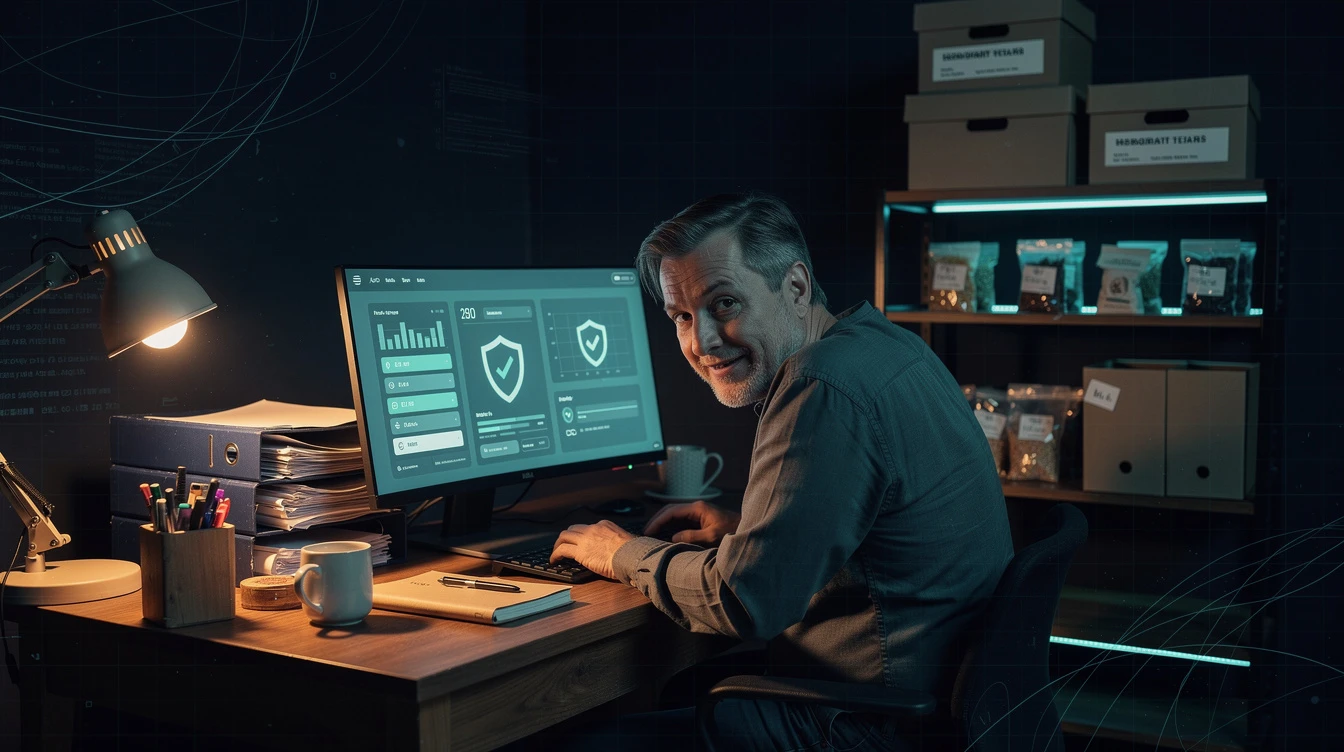
A Letterkenny business owner told us recently that she checks her email at 2am not because she is expecting a client message — but because she is half-expecting a ransom note. She runs a ten-person professional services firm. She has no dedicated IT person, no security policy, and no insurance that would cover a cyber incident. She knows it. And that knowledge follows her home every evening.
If you run a business with five to fifty employees in Ireland, you already wear too many hats. You manage the sales, the operations, the cash flow, and the HR. But lately there is a new, invisible weight on your shoulders: cybersecurity.
For the owner-operator, a cyberattack is not just an "IT issue." It is a deeply personal threat that strikes at the heart of your livelihood, your reputation, and your mental wellbeing.
1. The Lonely Burden of the Owner-Operator
For most SME owners, the company is an extension of themselves. You are not just managing a business — you are stewarding your life's work.
A staggering majority of Irish SMEs rely solely on the owner to handle cybersecurity decisions, usually without any dedicated expertise. Research shows that many small business owners say this adds significantly to their mental load, with many experiencing direct stress, frustration, and anxiety about the potential impact of a breach.
You are expected to fight off sophisticated global criminal syndicates while trying to get payroll out on Friday. It is an unfair fight, and the stress is entirely justified.
Are you the sole person responsible for your company's security? Book a free 20-minute strategy call — we work with Irish SME owners across Donegal and beyond to remove this burden.
2. The "Extinction-Level" Financial Threat
This is the ultimate nightmare: the digital keys to your kingdom are stolen, operations grind to a halt, and you face a ransom demand you cannot afford.
This is not fear-mongering — it is a statistical reality for Irish businesses. Even if you survive the initial hit, the fallout is devastating: downtime, legal fees, regulatory notifications, and recovery costs that can run into tens of thousands of euro. Compounding this risk is the fact that a large majority of Irish SMEs have no cyber insurance, leaving them completely exposed to the financial ruin of an attack.
Security is not an IT expense any more. It is an investment in your sheer survival. The most damaging attacks are also among the most preventable. Ransomware protection does not require a large budget — it requires the right controls applied in the right order. Offline backups, endpoint detection, and tested recovery procedures can mean the difference between a bad week and a business-ending event. An Garda Síochána has confirmed that ransomware incidents targeting Irish businesses have increased significantly in recent years[^1].
3. The Death of a Hard-Earned Reputation
In Ireland, business runs on relationships. Your reputation is built on years of trust, word-of-mouth, and delivering for your community. A data breach can shatter that foundation overnight.
Following a cyber incident, businesses have to divert massive resources just to rebuild trust with clients and partners. In a close-knit market, word travels fast. When customer data is compromised, many clients simply take their business elsewhere — and many never come back.
You do not just fear losing data. You fear looking negligent to the people who trusted you.
This is particularly acute under GDPR and the NIS2 Directive, which now require Irish businesses to notify the Data Protection Commission within 72 hours of a data breach[^2]. Failure to do so compounds the reputational damage with regulatory penalties. For an SME without a documented incident response plan, that 72-hour window passes in a blur of panic and confusion.
4. The Paralysing "Fear of the Unknown"
Perhaps the most pervasive anxiety is knowing you are vulnerable but feeling powerless to fix it. You are an expert in your industry, not in cyber defence.
The picture for Irish SMEs is stark when it comes to baseline security controls:
| Security Baseline | Status for Many Irish SMEs |
|---|---|
| Multi-Factor Authentication on critical apps | Not yet implemented by majority |
| Staff cybersecurity training | Never completed in many firms |
| Documented security policy | Absent in most small businesses |
| Tested incident response plan | Never tested by most SMEs |
This is not happening because owners are lazy or careless. It is happening because they are paralysed by jargon, complexity, and a lack of clear guidance that speaks to their actual situation. The NCSC Ireland provides practical guidance designed specifically for small and medium businesses — but most owners do not know where to start even with that resource available[^3].
The solution is not to become a cybersecurity expert. It is to have one in your corner.
The Pragmatic Solution: From Chaos to Control
You do not need to become a cybersecurity expert to protect your business. You just need a clear, actionable roadmap that removes the guesswork and lifts the burden off your shoulders.
At Pragmatic Security, we do not do jargon, and we do not do scare tactics. We partner with Irish SMEs to build straightforward, compliant, and cost-effective security plans — so you can go back to doing what you do best: running your business.
A cyberattack should not be a death sentence for your business. We make sure it is not.
What Next
Name your biggest fear. Is it ransomware locking your systems, invoice fraud emptying your account, or a data breach exposing your clients' information? Naming the specific threat is the first step to addressing it with proportionate controls.
Take a baseline assessment. A structured security assessment does not require a large budget or a full-time IT team. It does require honesty about what controls you have and which ones you are missing — and the willingness to prioritise the gaps that matter most.
Book a conversation. The most useful thing most Irish SME owners can do this week is have a 20-minute conversation with someone who can translate the risk into plain English and give them a clear list of what to do first.
Related Reading
- When Should an SME Hire a vCISO? 7 Warning Signs
- What Your Cyber Insurer Wants to See — and How to Get There Fast
- Your Systems Are Encrypted Right Now — What to Do in the First 60 Minutes
[^1]: An Garda Síochána — Cyber Crime [^2]: Data Protection Commission Ireland [^3]: NCSC Ireland — Advice for Organisations
Pragmatic Security — Cybersecurity advisory for Irish businesses. Based in Donegal, Ireland. CISA, CISSP, CISM certified advisors.