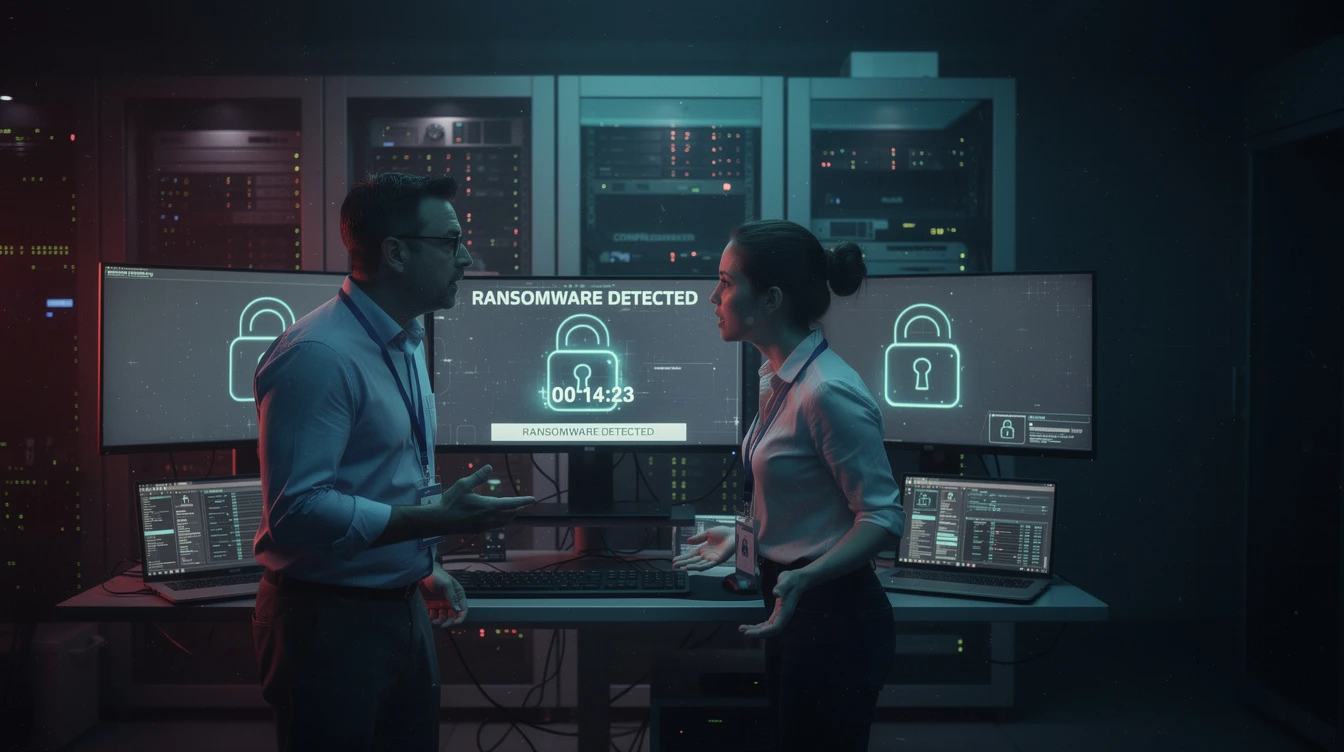
It was the busiest weekend of the summer season when the booking system went dark. A Sligo hotel, operating at near capacity, lost access to its property management system, point-of-sale terminals, and guest Wi-Fi at 11pm on a Friday. The attack was ransomware. The encryption had been running since the early hours of that morning — long enough to have reached every system on the network. By the time the owner arrived at 7am to find the ransom note on the reception computer, the damage was complete. What followed were three days of manual operations, lost bookings, stranded guests, and a recovery cost that the owner, reflecting on it months later, described as the most expensive lesson their business had ever received. This scenario is based on composite incidents affecting Irish hospitality businesses. The details are illustrative. The consequences are not.
How the Attack Unfolded
The initial breach had happened weeks earlier, through a phishing email that a member of staff had opened on the hotel's shared office computer. The email appeared to come from a booking platform and contained a link to what looked like a login page. The staff member entered their credentials. The attacker captured them and spent the following weeks moving quietly through the network — identifying systems, escalating privileges, and mapping the hotel's digital infrastructure.
The encryption event was timed for maximum impact: a Friday night of a peak weekend, when recovery would be slowest, guest impact would be greatest, and financial pressure to resolve the situation quickly would be at its highest. This is not coincidence. Ransomware operators study their targets and choose their moment deliberately.
The NCSC Ireland has published guidance specifically noting that ransomware attacks on Irish hospitality businesses follow recognisable patterns — initial compromise through phishing or credential theft, extended dwell time within the network, and encryption timed for maximum operational disruption.[^1] The Sligo hotel's experience matches that pattern precisely.
Does your hotel have a tested incident response plan that tells your team exactly what to do in the first four hours of a cyberattack — including who to call, how to communicate with guests, and how to begin manual operations? Book a free 20-minute strategy call — we will help you build one before you need it.
The Three Days: What the Owner Experienced
On day one, the immediate priority was keeping the hotel functioning in some form. Staff took bookings by phone and recorded them on paper. Restaurant orders were written by hand and passed to the kitchen physically. Payment terminals — separate from the hotel's property management system — remained functional, which was a significant piece of luck rather than planning. Guest check-in was manual, using paper registration cards that most of the front desk team had never used before.
The owner contacted their IT provider, who confirmed that the scale of the encryption made rapid recovery impossible without either paying the ransom or restoring from backup. The backup, it turned out, had not been tested in eighteen months. When the IT provider attempted to restore from it, significant data was missing. The last functional backup predated the current reservation system configuration by six months. A full restoration would require rebuilding from that point, losing months of booking history and system configuration.
An Garda Síochána's National Cyber Crime Bureau was contacted on day one. They advised against paying the ransom — a position consistent with their guidance for all Irish businesses — and provided a case reference for the insurance claim. The hotel's cyber insurance policy covered incident response costs and some business interruption losses, though the claims process added its own administrative burden during the crisis.[^2]
By day three, partial systems had been restored. The booking platform was functional with a new installation. The point-of-sale system was back online. Guest Wi-Fi remained offline for another week while the network was rebuilt and verified as clean.
The Three Decisions the Owner Regrets
Looking back, the owner identified three specific decisions — or rather, three non-decisions — that transformed a recoverable situation into a three-day crisis.
The first was the backup architecture. The hotel had a backup system. It ran automatically every night. But the backup was stored on a network-attached drive — connected to the same network as everything else. When the ransomware encrypted the hotel's systems, it encrypted the backup drive too. The 3-2-1 backup rule — three copies, two media types, one off-site — exists specifically to prevent this outcome. An off-site or cloud backup with a separate authentication credential would have survived the attack intact. Instead, the most recent usable backup was six months old.
The second was the absence of multi-factor authentication on the email system and the booking platform login. The initial compromise happened because a staff member's credentials were captured through a fake login page. If MFA had been enabled, those credentials would have been useless to the attacker — they would not have been able to use the stolen username and password without also having access to the staff member's phone. MFA costs nothing on Microsoft 365. Enabling it takes less than twenty minutes. The Data Protection Commission in Ireland has cited the absence of MFA as an aggravating factor in data breach investigations.[^3]
The third regret was the flat network. Every system in the hotel — booking platform, POS, guest Wi-Fi, staff computers, office systems — was on the same network segment. Once the ransomware was inside the network, it could reach every device. Basic network segmentation — separating guest Wi-Fi from operational systems, separating POS from the main office network — would not have prevented the attack, but it would have contained it, potentially leaving some systems functional during the recovery period.
What the Owner Changed After
Within three months of the incident, the hotel had made three specific changes. Off-site cloud backups were configured with separate credentials and tested monthly. Multi-factor authentication was enabled across all staff email accounts and the booking platform. The network was segmented, with guest Wi-Fi and POS terminals moved to separate VLANs isolated from the main office network.
These three changes did not require significant capital expenditure. They required decision-making, planning, and a morning of IT work. The owner's conclusion, repeated to anyone in the Irish hospitality sector who would listen, was direct: none of what happened was inevitable. Every element of the attack and its consequences could have been reduced significantly by controls that were available, affordable, and that the owner simply had not implemented.
The cost of three days offline for a hotel in peak season is measured in tens of thousands of euros. The cost of the controls that would have limited the damage is measured in hundreds. That arithmetic is worth thinking about before the weekend the attack arrives.
Three Actions to Take Before Your Next Season
1. Test your backup restoration today. Do not assume your backup works because it runs automatically. Identify your most recent backup and test restoring a sample of data from it. Confirm that the backup is stored in a location the attacker could not reach — off-site, in the cloud with separate credentials, or air-gapped.
2. Enable multi-factor authentication on every staff email account and every platform your booking and POS systems use. If you are on Microsoft 365, enabling Security Defaults takes twenty minutes and requires no additional cost.
3. Speak to your IT provider about network segmentation. Ask specifically whether your guest Wi-Fi, your POS systems, and your property management system are on separate network segments from each other and from your staff computers. If the answer is no, ask for a quote to fix it. For most small hotels, this is a modest cost with a significant security benefit.
Related Reading
- Ransomware Kills Businesses: The Evidence Every Irish SME Owner Must See
- Backup Strategy for SMEs: The 3-2-1-1-0 Rule Explained
- NIS2 and Hospitality: What Donegal and Sligo Hotels Must Do Before the Deadline
[^1]: NCSC Ireland, guidance on ransomware and cyber incident response for organisations: https://www.ncsc.gov.ie/advice-for-organisations/ [^2]: An Garda Síochána, National Cyber Crime Bureau cybercrime resources: https://www.garda.ie/en/crime/cyber-crime/ [^3]: Data Protection Commission, guidance on technical security measures and data breach obligations: https://www.dataprotection.ie
Pragmatic Security — Cybersecurity advisory for Irish businesses. Based in Donegal, Ireland. CISA, CISSP, CISM certified advisors.