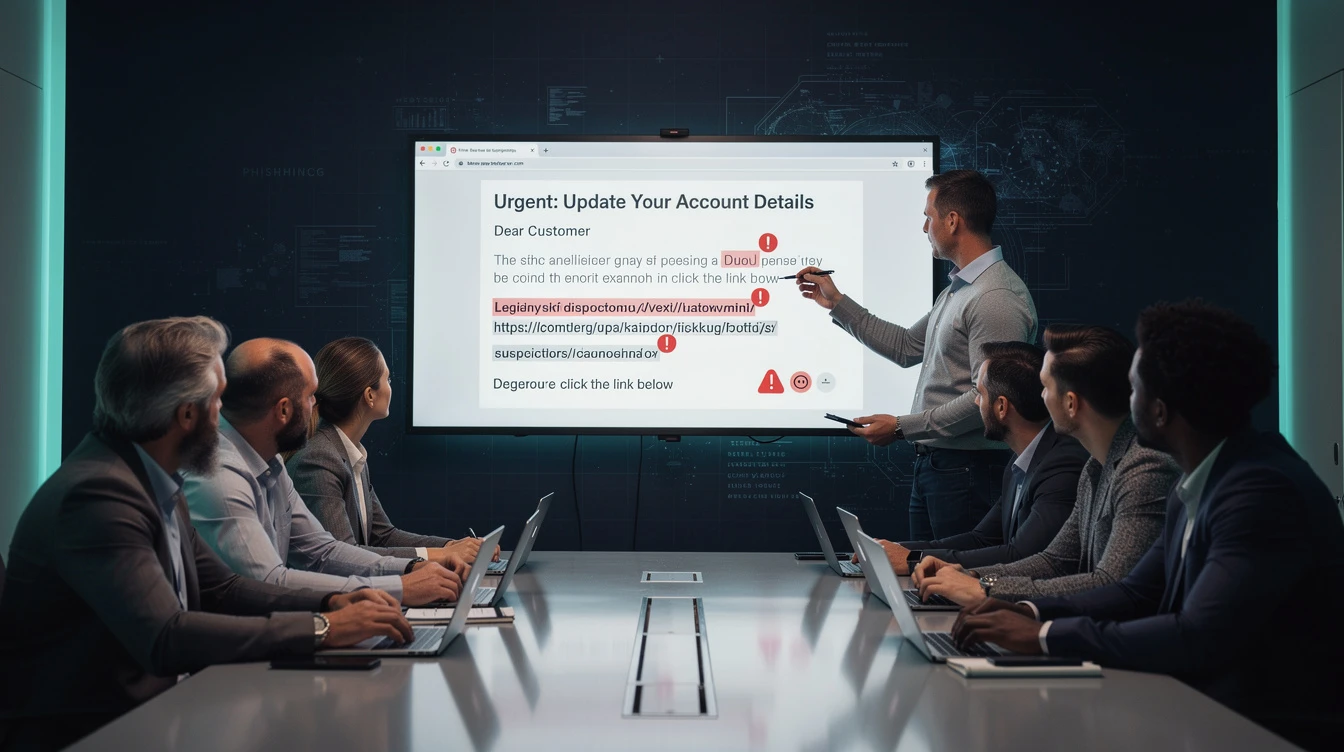
When a Letterkenny engineering firm's accounts manager received an email appearing to come from the managing director asking her to process an urgent supplier payment while the director was travelling, she complied without calling to verify. The email had been sent from a Gmail account that was one letter different from the director's real address. The payment of €23,000 went to a criminal's account. When the real director returned and the error was discovered, the funds were already gone. The accounts manager had never been trained to recognise this type of attack. Nobody in the firm had been.
That gap — between the technical sophistication of an attack and the awareness of the person it targets — is the most consistently exploited vulnerability in Irish business cybersecurity. Your employees, when properly trained, become your strongest defence. Without training, they are the path of least resistance into your business.
The Human Factor in Irish Cyber Incidents
Cybercriminals target people rather than systems because it is easier and cheaper. Social engineering, phishing, and business email compromise work because they exploit human psychology — urgency, authority, trust, and habit — rather than technical vulnerabilities. The NCSC Ireland's annual threat assessment consistently identifies human-targeted attacks as the primary mechanism through which Irish businesses are compromised.[^1]
The evidence from Irish incidents supports this. A Sligo hotel's booking system was encrypted by ransomware that entered through a phishing email a staff member clicked during a quiet Sunday morning shift. A Dublin law firm's email was compromised for eleven months after a partner entered his credentials into a convincing fake login page. A Cork manufacturing firm's finance team processed three fraudulent invoices over six weeks because an attacker had been monitoring internal email correspondence after compromising a supplier's account.
In each case, the attack exploited a human decision made under normal working conditions. No amount of technical security controls fully compensates for staff who do not know what a phishing email looks like, who feel too embarrassed to report a mistake, or who are not empowered to verify unusual requests before acting.
What Effective Training Looks Like
Effective employee cybersecurity training is not a one-hour annual presentation. Research consistently shows that short, regular, role-specific training produces better behaviour change than infrequent longer sessions. An Irish SME with fifteen employees can run a meaningful training programme with minimal cost and time investment if it is structured correctly.
New employees should receive security onboarding as part of their induction — covering your password policy, how to recognise phishing emails, what to do if they suspect a security incident, and the specific risks relevant to their role. A receptionist who handles incoming calls needs different training from a finance team member who processes payments. Generic training is better than nothing, but tailored training is demonstrably more effective.
Quarterly refresher sessions — even thirty minutes per quarter — keep security awareness current as the threat landscape evolves. These sessions work best when they draw on recent, relevant examples. An Garda Síochána's Garda NCCB publishes regular updates on the types of attacks targeting Irish businesses that make excellent training material.[^2] Real Irish incidents land differently than abstract statistics.
When did your staff last receive security awareness training that included practical phishing examples? Book a free 20-minute strategy call — we design and deliver employee cybersecurity training programmes for Irish SMEs that fit within normal working hours and produce measurable behaviour change.
The Non-Negotiable Topics for Every Irish Business
Every employee in an Irish SME should be able to pass a basic test on five topics. These are not advanced concepts. They are the minimum required to avoid being the person who causes a preventable incident.
Phishing recognition is first. Your staff should know that phishing emails often create false urgency, impersonate trusted senders, request credentials or payment, and include links that look plausible but lead somewhere unexpected. They should know to hover over links before clicking, to check the actual sender email address rather than the display name, and to verify any financial request by calling the person directly on a known number.
Password hygiene and multi-factor authentication come second. Every staff member should understand why reusing passwords across personal and work accounts creates risk, how to use a password manager, and why MFA — even when it feels inconvenient — is the single most effective control against account takeover. The Data Protection Commission has noted that credential compromise in Irish SMEs is consistently one of the most common causes of notifiable data breaches.[^3]
Third is the payment verification procedure. Every person who has any role in processing payments — including managers who approve them — must understand that no change to bank account details should ever be acted on without voice confirmation to a pre-existing phone number from your records. Not a reply to the email. Not a call to the number in the email. A call to the number you already have.
Fourth is incident reporting. Staff need to know that reporting a suspicious email or a mistake they made is the right thing to do, that they will not be punished for reporting, and exactly who to contact and what information to provide. The instinct to say nothing after clicking something suspicious — to hope it was nothing — is precisely what allows incidents to escalate from manageable to catastrophic.
Fifth is physical and remote working security. Staff who work from home or on the move need to understand that public Wi-Fi is insecure, that screens should be locked when unattended, and that printing or photographing confidential documents away from the office creates risks that do not exist in a controlled office environment.
Building a Security Culture
Training programmes work best in organisations where the leadership visibly takes security seriously. If the managing director ignores the password policy or bypasses MFA because it slows them down, no amount of staff training will produce a security-conscious culture. The most effective signal management can send is compliance with the same rules they expect from everyone else.
Make it safe to report. The fear of blame is the biggest barrier to timely incident reporting in Irish businesses. A staff member who clicked a phishing link and is worried about being fired will say nothing for as long as possible — and that silence is often the difference between a contained incident and a full breach. Create an explicit written commitment that reporting is rewarded, not punished, and that the goal is to contain and learn, not to assign blame.
What Next: Three Actions for Irish Business Owners
First, run a phishing awareness briefing with your full team this month. Use a real recent example from the NCSC Ireland or An Garda Síochána's published guidance. Walk through what made it convincing, what the red flags were, and what the correct response would have been. Thirty minutes. No specialist equipment required.
Second, write a one-page payment verification procedure and brief it at the next team meeting. One rule: any change to supplier bank details must be confirmed by voice call to a pre-existing number before any payment is made. Brief it personally. Post it in the finance area.
Third, schedule quarterly security refreshers in the calendar now for the rest of 2026. If they are in the calendar, they happen. If they are not, the next busy period will crowd them out and your staff will go another year without updated guidance on the threats targeting Irish businesses.
[^1]: NCSC Ireland — Advice for Organisations [^2]: An Garda Síochána — Cybercrime [^3]: Data Protection Commission Ireland
Related Reading
- Phishing Protection: Essential Training for Your Irish Workforce
- Building a Security Culture: A vCISO Approach
- Phishing Simulations: How to Run Them Without Destroying Employee Trust
Pragmatic Security — Cybersecurity advisory for Irish businesses. Based in Donegal, Ireland. CISA, CISSP, CISM certified advisors.