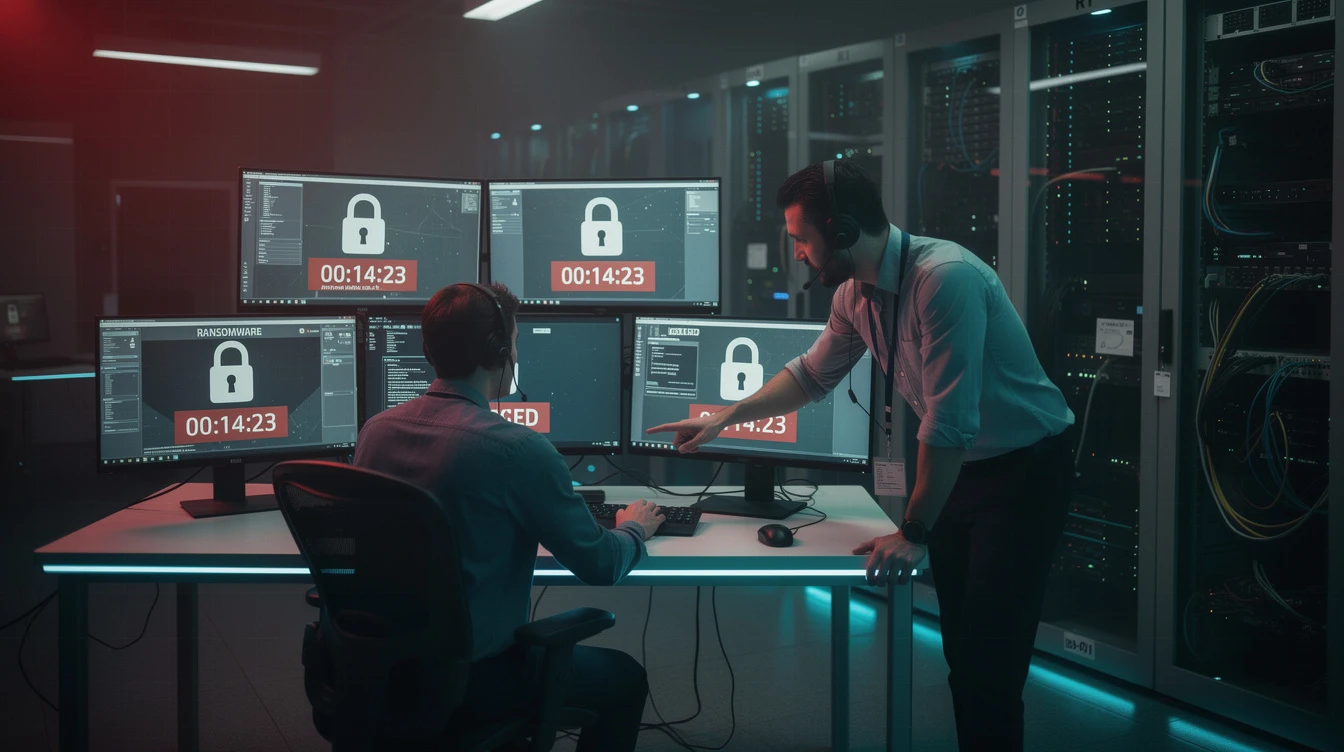
When a prominent Sligo hotel fell victim to a ransomware attack in 2024, the attackers encrypted booking records, guest information, and financial data. The hotel's operations were crippled for over a week. Future bookings were thrown into chaos. The recovery cost, including IT forensics, system rebuilding, and legal fees, exceeded €200,000. The business had no offline backup and no documented incident response plan. Three months later the reputational fallout was still visible in their review scores.
For hotels and guesthouses across Donegal and Sligo, this is not a distant threat. The hospitality sector collects more personal data per employee than almost any other industry — guest names, addresses, payment card details, passport numbers, dietary requirements, and preferences that can reveal sensitive information. That data concentration makes the sector a consistent target for cybercriminals, and the interconnected nature of modern hospitality systems means a compromise in one area can quickly cascade across the entire operation.
Why Hospitality Is a High-Value Target
Your booking platform, property management system, point-of-sale terminals, and guest WiFi are all connected, often insufficiently segmented from one another. A malicious actor who gains access through one system can use it as a stepping stone to reach the others. An attacker who compromises a guest WiFi router that shares network infrastructure with your reservation system can, without proper segmentation, reach booking records and payment data from the same entry point a guest used to watch Netflix.
Point-of-sale systems are a specific target. Attackers who install card skimming software on POS terminals collect payment card data silently for weeks before discovery. For a Donegal hotel processing hundreds of card transactions daily, the GDPR obligation to notify the Data Protection Commission applies regardless of the business's size.[^1]
Booking platform fraud is a related risk. Attackers who gain access to your booking system can manipulate reservations, extract guest data for resale, or reroute payment confirmations. For guesthouses relying on advance bookings, disruption during peak season directly affects occupancy and revenue.
Do you know whether your guest WiFi network is properly separated from your property management and POS systems — and who in your team is responsible for that configuration? Book a free 20-minute strategy call — we'll review your network architecture and identify the highest-risk exposure points for your property.
The Five Controls That Matter Most
Network segmentation is the first and most foundational control for hospitality businesses. Your guest WiFi must be completely separate from your operational network — not just a different SSID, but a different network with no routing path between the two. A guest device with malware connecting to an unsegmented network can reach your booking system, your POS, and your employee records. Proper segmentation removes that attack path entirely. Your IT support provider should be able to confirm whether true network segmentation is in place — not just separate names on the same hardware.
Strong authentication on every admin account is the second control. Every account with access to your booking platform, POS management system, property management software, or email should require multi-factor authentication. This is not just a security good practice — it is a warranty condition in most current cyber insurance policies and an expectation of the NCSC Ireland's guidance for organisations handling personal data.[^2] The accounts of staff who have left should be disabled immediately, not left active. Admin credentials should never be shared.
Software updates applied promptly is the third control. Your property management system, booking engine, POS software, and operating systems all receive security updates that close known vulnerabilities. Many ransomware attacks affecting Irish hospitality businesses exploited vulnerabilities with available patches. A documented patching schedule, verified monthly, keeps your attack surface from growing.
Secure, tested backups are the fourth control and the one that determines whether a ransomware attack is a recoverable inconvenience or an existential crisis. The Sligo hotel in our opening example had no offline backup. Offline backups — stored in a location that cannot be reached from your compromised network — are the recovery path that makes ransom payment unnecessary. These should be tested quarterly: run a restoration, confirm the data is complete and accessible, and document the result. An untested backup is a hypothesis, not insurance.
Staff security awareness is the fifth control, because your team is both your strongest defence and your most commonly exploited vulnerability. An Garda Síochána's National Cyber Crime Bureau documents phishing as a primary entry point for attacks against Irish businesses, and hospitality reception staff and accounts payable teams are frequent targets.[^3] A phishing simulation and a thirty-minute security briefing annually — covering what suspicious emails look like, how to verify unexpected payment requests, and who to call if something seems wrong — is the minimum investment that makes a measurable difference.
GDPR and Your Legal Obligations
Under GDPR, Donegal and Sligo hotels and guesthouses are data controllers with significant obligations around the personal data they collect from guests. A breach that exposes guest payment data or personal information must be reported to the Data Protection Commission within 72 hours of discovery. This is not optional and does not have a size threshold — a twelve-room guesthouse has the same notification obligation as a 200-room hotel.
The DPC also expects that you know what data you hold, where it is stored, who has access to it, and how it is protected in transit and at rest. A data audit — mapping where guest information goes from the booking form through to your accounting system — is both a GDPR compliance exercise and a security exercise. It reveals where data is duplicated unnecessarily, where it is held longer than required, and where access controls are missing.
Encryption of personal data in transit — which Cloudflare or a properly configured SSL certificate provides — is a baseline technical measure the DPC expects to see. If your booking website is not served over HTTPS, or if your property management system transmits data over unencrypted connections, these are gaps that a DPC investigation would highlight as failures to implement appropriate technical measures.
The Sligo hotel's €200,000 recovery cost was not inevitable. The controls that would have prevented or contained the attack were all available to any Irish guesthouse — most at no cost.
Three Steps for Donegal and Sligo Hospitality Owners
These three steps address the most common gaps in Irish hospitality cybersecurity — the same gaps that appear in the post-incident reviews of cases like the Sligo hotel and dozens like it across Ireland.
Ask your IT provider or network installer to confirm — in writing — that your guest WiFi is properly segmented from your operational network and cannot be used as a pathway to your booking, POS, or staff systems. If they cannot confirm this clearly, treat it as unconfirmed and request a review. Network segmentation is the single change most likely to prevent an attack from reaching your most sensitive systems.
Enable MFA on every admin account for your booking platform, property management system, and email. Start with the accounts that have financial access or access to guest personal data. This takes less than an hour per account on most platforms. Create a list of all admin accounts across every system and confirm MFA status on each — this list is also the starting point for your access control review.
Set up a tested offline backup for your booking data and guest records. This does not need to be complex — an encrypted external drive taken offsite weekly and rotated is a meaningful improvement over no offline backup at all. More robust cloud-based immutable backup solutions are available affordably. Test the restoration once per quarter and record the result. That record is your evidence that the backup works.
Related Reading
- Cyber Insurance for Donegal Hospitality: What Your Policy Misses
- Cloudflare and GDPR Compliance for Irish Businesses
- Building an Incident Response Plan for Irish SMEs
[^1]: Data Protection Commission Ireland — GDPR obligations for hospitality and data breach notification: https://www.dataprotection.ie [^2]: NCSC Ireland — Security guidance and controls for organisations handling personal data: https://www.ncsc.gov.ie/advice-for-organisations/ [^3]: An Garda Síochána — Cybercrime guidance and phishing threat reporting for Irish businesses: https://www.garda.ie/en/crime/cyber-crime/
Pragmatic Security — Cybersecurity advisory for Irish businesses. Based in Donegal, Ireland. CISA, CISSP, CISM certified advisors.